Can you buy an authentic Aztec death whistle? Not an original. Ancient skull whistles are protected archaeological objects in Mexico and cannot legally be sold or exported. So when a shop says “authentic Aztec death whistle,” the only honest meaning is a faithful replica: a modern whistle built on the design of the originals, with the same skull form and the same two-chamber principle that makes the scream. This guide explains what that means and how to pick a good one.
For the archaeology itself (where the originals were found and what they sound like), see are Aztec death whistles real?. This page is about buying.
Why you can’t buy an original
- The law. Under Mexico’s 1972 Federal Law on Archaeological, Artistic and Historic Monuments and Zones, objects from the cultures before the Spanish arrival are archaeological monuments and the inalienable property of the nation. Their export is banned without special authorization.
- Where they are. Known originals are in institutional hands: the Tlatelolco whistles with INAH in Mexico, and five more at the Ethnological Museum in Berlin, according to the 2024 study by Sascha Frühholz and colleagues. Our Aztec death whistle history tells how they were found.
So a listing that offers an “ancient,” “excavated” or “original” death whistle is either mislabeling a modern piece or offering something with no legal provenance. Either way, walk away. Our article are Aztec death whistles illegal? covers what is and isn’t allowed with replicas.
What “authentic” should mean in a listing
A replica earns the word “authentic” when it is faithful to the originals in the ways that matter:
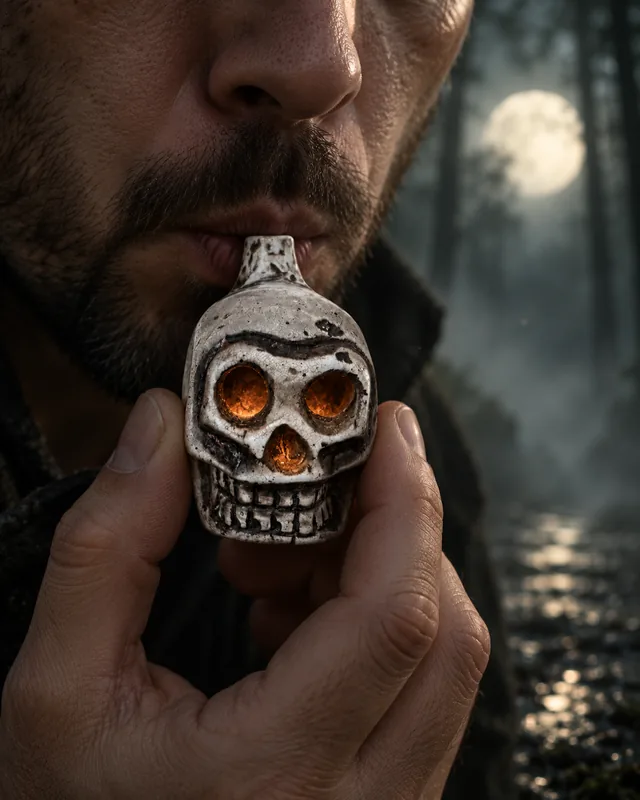
- The skull form. The originals are small clay skulls. A good replica follows that shape rather than a cartoon skull.
- The internal design. The Zurich study describes “two opposing sound chambers that create physical air turbulence” as the source of the screech (ScienceDaily). That internal geometry is what makes a death whistle scream. A skull shape with an ordinary whistle inside will just whistle.
- Honest description. A faithful replica is sold as a replica, with its material stated plainly, and without claims it cannot prove.
Replica vs cheap imitation: what actually matters
| Check | Faithful replica | Cheap imitation |
|---|---|---|
| Sound | Rough, rushing, scream-like noise when blown hard | Clean, simple whistle tone |
| Internal design | Two opposing chambers, as described in the 2024 study | A single simple whistle |
| Demo | Real audio or video of that exact product | Borrowed viral clip, or nothing |
| Claims | ”Replica,” material stated | ”Ancient,” “original,” or exact loudness figures without a source |
| After-sale | Clear delivery time and returns | Vague or missing policies |
Does the material matter?
Less than most listings suggest. The originals are clay, and clay replicas are common, but the scream comes from air turbulence inside the chambers, so the internal geometry is what counts. Replicas in other materials exist, including 3D printed ones; the Zurich team itself worked with 3D reconstructions of originals. If you are curious about printed versions, read our 3D printed Aztec death whistle guide. What matters for you as a buyer is that the seller states the material honestly and shows the real sound.
A note on loudness claims
You will see exact decibel figures in many listings. We have not found a published measurement standard for these replicas, and output depends on the piece and on how hard you blow, so treat any precise number without a source as marketing. Also know that music archaeologist Arnd Adje Both, who has tested originals, reports that they sound softer and more like wind than the loudest replicas (Wikipedia). A replica built to shriek is faithful to the design, and louder than some originals.
Red flags before you buy
- “Ancient,” “excavated,” “original” or “museum piece” for a product under a few hundred dollars. Originals are not legally for sale.
- No demo of the actual item. A seller who reuses someone else’s viral video has not shown you what you will receive.
- Precise decibel or frequency claims with no source.
- Materials that change between the title and the description.
- No stated delivery time, no tracking, no returns. A trustworthy shop tells you where the order ships from, how long it takes and how to send it back.
- “Mayan death whistle” presented as a different, rarer object. It is usually the same Aztec design; see Mayan death whistle vs Aztec.
Getting the scream out of any replica
Even a well-made replica can disappoint on the first try, because the technique differs from an ordinary whistle. Our how to use an Aztec death whistle guide covers the grip and breath that get the full sound, and the sound guide lets you hear what to aim for.
Our replica, described plainly
We sell an Aztec death whistle replica that follows the skull design of the originals. We call it a replica because that is what it is.
- Price: $34.99 for one, $59.99 for two, $79.99 for three.
- Delivery: tracked, 7 to 13 days to the US, 4 to 16 days to Canada, the UK, Ireland, Australia and New Zealand.
- Returns: 30 days.
If it does not do what you expected, the return window is there for that. For a wider comparison of what is on the market, read our best Aztec death whistle guide or our page on Aztec death whistles for sale.
FAQ
Can I buy an authentic, original Aztec death whistle?
No. Originals are archaeological monuments under Mexico’s 1972 federal law, the property of the nation, and cannot legally be sold or exported. Every death whistle for sale is a modern replica.
What does “authentic Aztec death whistle” mean in a shop?
It should mean a faithful replica: the skull form of the originals and the two opposing internal chambers that create the scream. It should never mean an ancient object.
Is a replica as loud as the original?
Often louder. Arnd Adje Both reports that originals he tested sound softer and wind-like, while many replicas are built and played to maximize the scream.
Does a death whistle have to be ceramic to scream?
No. The originals are clay, but the sound comes from air turbulence inside the two chambers, so internal shape matters more than material. Printed and other non-clay replicas exist.
How do I spot a fake “original”?
Any listing calling a death whistle ancient, excavated or original, especially at a normal retail price, is either mislabeling a replica or selling something you should not buy.
Sources
- Mexico, Federal Law on Archaeological, Artistic and Historic Monuments and Zones (1972), English text via UNESCO.
- Frühholz et al., “Psychoacoustic and Archeoacoustic nature of ancient Aztec skull whistles,” Communications Psychology, 2024 (PMC11555264); ScienceDaily summary (November 2024).
- Wikipedia, “Aztec death whistle” (Arnd Adje Both on the sound of originals).