An Aztec death whistle sounds like a person screaming into the wind: a shrill, ragged shriek riding on a hiss of rushing air. Blow gently and you get a hollow, wind-like hiss; blow hard and that hiss tears open into a piercing scream that most people hear as a human voice.
Press play on the player at the top of this page and switch between Soft, Medium and Full to hear how much the sound depends on your breath. The note under the player tells you whether you are listening to a recording of our replica or a synthesized approximation, so you always know what is coming out of your speakers. Then read on for what happens inside the skull, and why your brain reacts before you have time to think.
What does an Aztec death whistle sound like?
The scream
At full breath, the whistle gives one sustained, piercing cry. It is nothing like a referee’s whistle or a flute. There is no clean note to hum along to, just a high, rough edge that wavers slightly as your air runs out. It sounds less like music and more like something alive and in distress.
That is not only a marketing impression. In a 2024 study from the University of Zurich, listeners who had never heard a skull whistle were asked to name the source of each sound they heard. For skull whistles, the most frequent answer was “scream” (Frühholz et al., Communications Psychology, 2024).
The wind underneath
Under the scream there is always air. It is a broad, breathy rush, close to wind forced through a gap or steam escaping a kettle. The same study describes skull whistles as producing a noisy, wind- or hiss-like sound, and some listeners in its naming test reached for technical sources such as vehicles or kettles rather than voices. At a soft breath, that wind is the whole sound. It is quieter, but many people find it the eeriest setting of all.
How it changes with your breath
- Soft: a hollow hiss, like wind in a doorway at night. Little or no pitch.
- Medium: the hiss picks up a high, wailing edge. This is where it starts to sound like a voice.
- Full: the airflow breaks up into a rough, distorted shriek. This is the famous scream.
One thing the whistle cannot do is play a tune. According to the Zurich researchers, its construction does not allow large changes in sound during playing. You get a single, noisy, piercing cry, shaped mostly by how hard and how long you blow.
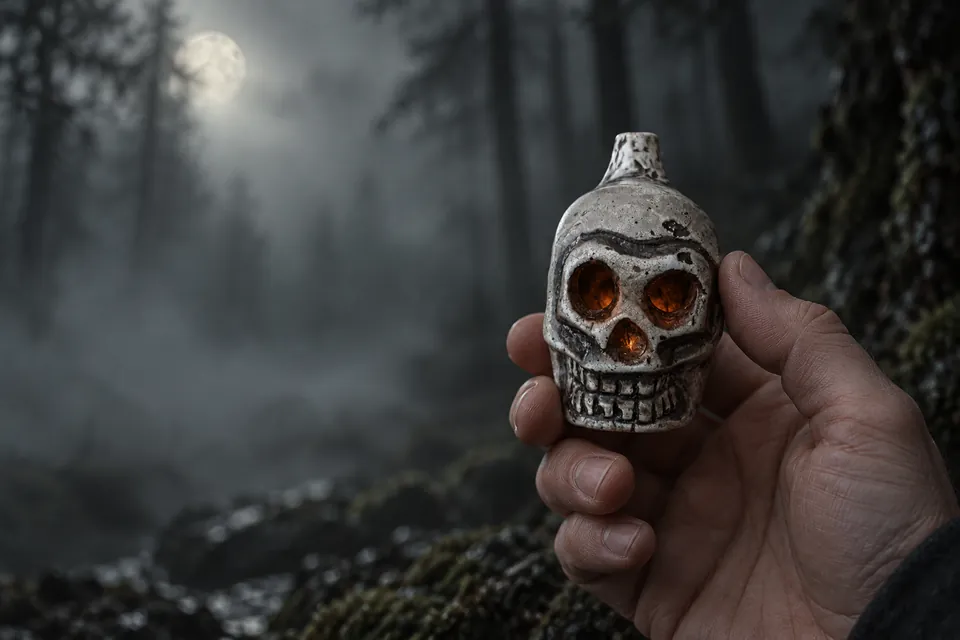
Why does it sound like a human scream?
Inside the skull: colliding air
A skull whistle is not built like an ordinary whistle. The study, drawing on earlier work by music archaeologist Arnd Adje Both, describes four parts: a tube-shaped air duct with a narrowed passage, a rounded counterpressure chamber, a collision chamber between the two, and a bell-shaped cavity. The researchers explain the mechanism through the Venturi effect: air is drawn in, streams of air collide, and turbulence builds. At high playing intensity and air speed, that turbulence distorts the sound and gives it its rough, piercing character.
To check this, the team made CT scans of an original skull whistle held by the Ethnological Museum in Berlin and of two clay replicas copied from Berlin originals by Both and ceramist Osvaldo Padrón Pérez. The 3D reconstructions showed originals and replicas were nearly identical in structure and airflow, and recordings of both were acoustically very close. We go deeper into the chambers in how an Aztec death whistle works.
Rough, noisy and piercing
When the researchers analyzed the recordings, they found broadband noise mixed with high-pitched elements. The noisy, rough pattern is one the study notes is often found in sounds with a scary meaning, such as primate screams and frightening music. At the same time, skull whistles lacked the slow, regular patterns that give human speech and animal calls their structure. Put simply, it is a scream with no words in it.
The team then compared skull whistles against a library of 2,262 natural and artificial sounds. The acoustically closest neighbors were modern Mexican clay flutes, non-speech human voices, and rough, shrill machine sounds such as alarm clocks, chainsaws and emergency horns.
What listeners felt
Across the rating experiments, skull whistle sounds were judged the most negative of all the sound categories tested. They also triggered a stronger urge to react than every other category and were rated as largely unnatural. When listeners described them in their own words, the top adjectives were “aversive” and “scary,” and “fear” was by far the most common emotion. The University of Zurich press release sums it up: listeners found the sound chilling and frightening, and heard it as partly natural, like a human voice or scream.
The researchers call this a hybrid natural-artificial sound. Your ear files it under “human,” then notices it also sounds mechanical, and cannot settle on either. Brain imaging backed this up: the auditory system flagged the sounds as emotionally significant, while higher-level brain areas worked to evaluate what they might mean. In the listening tests, sounds were played back at matched levels, so the fear came from the character of the sound, not from sheer volume.
Were these whistles used to terrify enemies in battle? The authors call that popular idea unsubstantiated. They suggest instead that Aztec communities may have used the scary, scream-like sound in ritual settings, perhaps tied to the wind god Ehécatl and the underworld. That fits where the best-known pair was found: with a sacrificed man at the temple of Ehécatl in Tlatelolco, Mexico City. The full story is in our Aztec death whistle history.
How the death whistle sound varies
Indoors vs outdoors
Indoors, hard walls and ceilings throw the sound back at you. The scream fills the room, feels closer, and turns harsher. Outdoors, with nothing to reflect it, the same blow sounds thinner and more distant, and the wind-like hiss comes forward. A quiet night makes any setting more unsettling, because there is nothing else for your ear to latch onto.
Live vs recorded
A recording flattens the whistle. Phone and laptop speakers struggle with broadband noise, and video platforms compress audio, so clips tend to sound tidier than the real thing. In the room, you hear the air, the roughness and the direction it comes from. That is the difference people describe when they say a video did not prepare them.
Whistle to whistle
Because the sound comes from turbulence rather than a fixed note, small differences in the air duct and chambers change the result. Two skull whistles of the same design can scream in slightly different voices, and the same whistle will sound different from one player to the next.
How to get the full scream
Most first attempts produce only the hiss. The scream needs a strong, steady column of air, not a quick puff:
- Seal your lips around the mouthpiece and keep your fingers off the openings.
- Start with a steady medium breath until the hiss grows a high edge.
- Push from your chest, harder and longer, and hold it. The tone breaks into the scream.
If it still sounds thin, adjust the angle slightly and try again. Our step-by-step guide covers grip, breath and every common problem: how to use an Aztec death whistle.
Where to hear real recordings
- The Zurich study’s own clips. The research lab behind the study hosts audio of an original skull whistle and of a replica played at low, medium and high air pressure. It is the most trustworthy reference online, because you know exactly what was recorded.
- YouTube. Search “aztec death whistle sound” and you will find many videos of people playing originals and replicas. Quality varies a lot, and some clips add reverb or effects in editing, so treat the most dramatic ones with caution.
- The player on this page. It plays a recording of an Aztec death whistle (not of our replica), shared with the permission of the Aztec Death Whistle channel. Turn your volume down first.
Safety: your ears and your pets
A death whistle is meant to be startling, so use it with some care.
- Never blow it next to anyone’s ear, including your own. Point it away from people.
- Give your ears a break. Repeated full-power blows in a small room are hard on hearing. If your ears ring, stop. For long practice sessions, earplugs are a sensible idea.
- Keep it away from pets. Dogs and cats hear high sounds more keenly than we do, and a scream-like noise can frighten them. Do not blow it at animals.
- Think about where you are. A realistic scream in public can make people believe someone is in real danger. Save it for places where everyone is in on it.
- Supervise children, especially the first few times.
FAQ
What does an Aztec death whistle sound like?
A shrill, rough scream riding on a hiss of rushing air. At a soft breath it is a wind-like hiss; at full breath it becomes a piercing shriek that most listeners describe as a human scream.
Why does the death whistle sound like a human scream?
Air collides inside the whistle’s chambers and becomes turbulent, which produces a noisy, rough, high-pitched tone. That acoustic pattern is close to screams and alarm sounds, so listeners in the 2024 Zurich study labeled it “scream” and rated it aversive and scary.
Where can I get a death whistle sound effect?
For listening, use the player on this page or the Zurich lab’s recordings. For a video or game project, only use a clip whose license allows it; sound libraries such as Freesound let you filter by license. Do not lift audio from other people’s videos.
Does a replica sound like an original?
In the Zurich study, clay replicas copied from museum originals sounded very similar to the originals in acoustic analysis. Our replica is not one of those study copies, and we have not compared it with a museum original, so we do not claim it is identical.
How loud is an Aztec death whistle?
Loud enough to fill a room and carry outdoors, but its power comes from the kind of sound it makes more than from raw volume. See how loud an Aztec death whistle is for more.
Ready to hear it in your own hands? Get the Aztec death whistle replica, or start from our home page to see the whole story.