In one sentence: an Aztec death whistle forces your breath through a narrowed air duct into a set of small internal chambers where the airflow collides and becomes turbulent, producing a noisy, wind-like hiss that turns shrill and scream-like when you blow hard.
That description comes from the most detailed scientific study of these instruments so far: Frühholz and colleagues, “Psychoacoustic and Archeoacoustic nature of ancient Aztec skull whistles”, Communications Psychology, 2024 (doi 10.1038/s44271-024-00157-7), led from the University of Zurich. Below we walk through what is inside the skull, what the researchers found about the sound, and what is still unknown.
What an Aztec death whistle is
The death whistle, or skull whistle, is a small aerophone (a wind instrument) shaped like a human skull, from the postclassic Aztec world of central Mexico. Excavations at the temple of the wind god Ehecatl-Quetzalcoatl at Tlatelolco, in Mexico City, found the remains of a sacrificed young man holding a skull whistle. The 2024 study dates that excavation to 1987 to 1989. The god of the dead, Mictlantecuhtli, and the underworld, Mictlan, are often linked to the object in popular writing, which is where the “death” nickname comes from. For the full archaeological story, see our history of the Aztec death whistle.
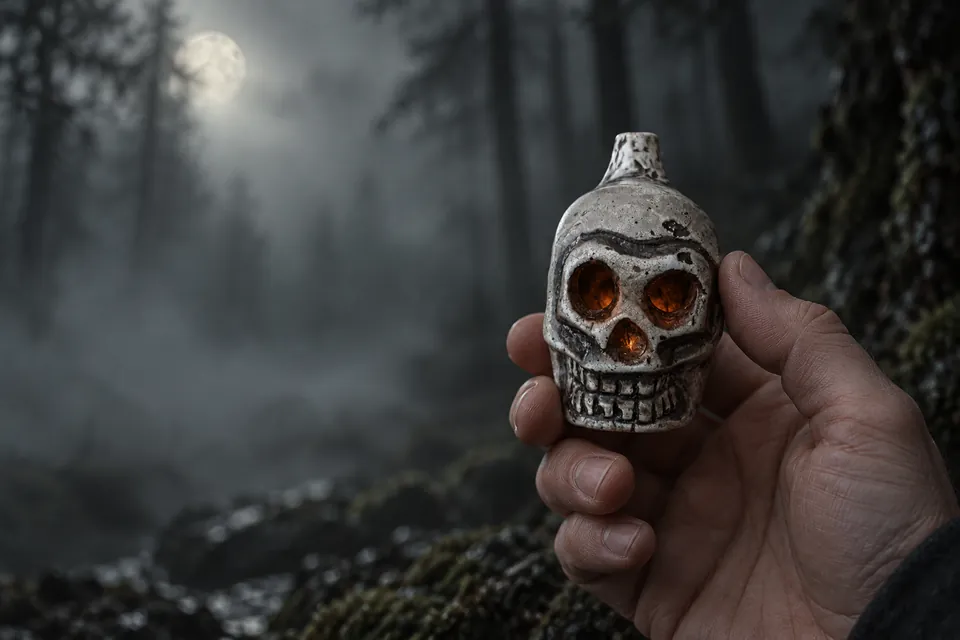
Aztec death whistle inside: the cross section
If you could cut a skull whistle in half, you would not find one simple tube like a referee’s whistle. The 2024 study, which examined original whistles and replicas, describes four parts:
- A tubular air duct with a constricted passage. You blow in here. The narrowing speeds the air up.
- A hemispherical counterpressure chamber. A rounded pocket that pushes air back against the incoming stream.
- A collision chamber. Where the incoming air and the pushed-back air meet and become turbulent.
- A bell cavity. The open space, inside the skull, through which the sound leaves the instrument.
In the researchers’ words, the whistle relies on the Venturi effect “generating a constant air aspiration, collision, and turbulence process”. Put simply: fast air creates suction, the flows collide, and the result is chaotic rather than a clean note.
How does the death whistle make sound?
When you blow, the narrowed duct accelerates your breath. The counterpressure chamber sends air back toward the incoming flow, and the two meet in the collision chamber. That meeting is unstable by design. Instead of settling into one steady vibration, like a recorder or a referee’s whistle, the airflow stays turbulent.
The study describes the result as broadband, noise-like sound (they compare it to pink noise) combined with high-pitched elements. That mix of noise and pitch is what gives the whistle its rough, harsh texture.
You may read elsewhere that the skull works as a Helmholtz resonator, like a bottle you blow across. That is a popular simplification; the 2024 paper instead explains the sound through the duct, counterpressure and collision chambers described above.
Why your breath changes everything
The same whistle can sound very different. According to the study, skull whistles produce a wind-like or hiss-like sound that “can have a shrill, piercing, and scream-like sound quality when played with intensive air pressure”. A gentle breath gives a breathy hiss; a hard, steady blow gives the scream. Our guide on how to use an Aztec death whistle covers the technique.
Why it sounds like a scream: what listeners reported
The Zurich team ran several listening experiments (70 people rated the sounds, and other groups of 40 to 76 people labeled or classified them) and scanned the brains of 32 listeners with fMRI. Their main findings:
- Listeners rated skull whistle sounds as highly aversive and scary.
- People classified them as a hybrid: partly voice-like and scream-like, partly mechanical or technical.
- The sounds were judged closest to Mexican flutes and to rough, shrill technical sounds such as alarm clocks or emergency horns.
- In the brain, the sounds engaged auditory regions that decode emotional significance, plus higher-order areas involved in evaluating what a sound means.
That is the honest basis for the “scream” reputation: a noisy, rough sound that the brain partly reads as a voice in distress and partly as a machine, which makes it hard to ignore. You can hear it on our Aztec death whistle sound page.
Why the design matters
Because the sound comes from turbulence inside small chambers, the exact geometry matters: the width of the narrowed passage, the shape of the counterpressure chamber, the size of the collision chamber and the openings. Small differences change how easily a whistle “catches” into its scream and how harsh it sounds. That is why two whistles that look similar can sound quite different.
Size matters too. Music archaeologist Arnd Adje Both, who tested original excavated whistles, described their sound as far softer than the famous shriek, closer to wind noise, according to the Wikipedia summary of his work (Both, “Aztec Music Culture”, The World of Music, 2007). The piercing sounds most people know usually come from larger modern reproductions.
How loud is it?
No independent, published measurement exists. Loudness depends on the whistle, the breath and the distance, and the “125 dB” figures on listings come without a method. In the 2024 study, all sounds were set to the same level for the experiments, so the paper does not report loudness as played. We cover this in detail in how loud is an Aztec death whistle and the loudest Aztec death whistle. Whatever the figure, never blow one toward anyone’s ear.
What happens when you blow it: step by step
- You seal your lips on the mouthpiece and exhale.
- The constricted air duct speeds up the airflow.
- The counterpressure chamber pushes air back against the incoming stream.
- The two flows collide in the collision chamber and become turbulent.
- Noise-like sound with high-pitched elements leaves through the bell cavity.
- With gentle breath you hear a hiss; with strong breath, a shrill scream.
- Your brain reads that rough sound as partly human, partly machine, and reacts.
What was it for?
The mechanism is now fairly well described. The purpose is not settled. Popular accounts often say Aztec warriors blew massed death whistles to terrify enemies, but there is no direct evidence for this. The 2024 study notes that solid evidence for any theory had been missing and, based on how the sounds affect listeners and on where whistles were found (ritual burials with human sacrifices), concludes that use in ritual contexts, especially sacrificial rites and ceremonies related to the dead, “seems very likely”, while warfare use seemed rather unlikely.
Mexican researcher Roberto Velázquez Cabrera also studied and reconstructed Mesoamerican wind instruments, including skull whistles, and his work is often cited in discussions of how they sound.
Want to try one?
Our replica Aztec death whistle is made to reproduce the skull whistle’s scream. Before buying, you can check are Aztec death whistles illegal? for where and how to use one responsibly, or head back to the home page.
Frequently asked questions
How does an Aztec death whistle work in one sentence?
Breath passes through a narrowed air duct into a counterpressure chamber and a collision chamber, where the airflow collides and turns turbulent, producing a noisy hiss that becomes a scream when blown hard.
What is inside an Aztec death whistle?
According to the 2024 Zurich study: a tubular air duct with a constricted passage, a hemispherical counterpressure chamber, a collision chamber and a bell cavity.
Why does the Aztec death whistle sound like screaming?
Its sound is rough and noise-like with high-pitched elements. In listening experiments, people rated it as scary and classified it as partly voice-like and scream-like, partly mechanical.
Is it a Helmholtz resonator?
That is a common popular explanation, but the 2024 study describes the mechanism differently: turbulence created by the Venturi effect and colliding airflows in the internal chambers.
Does the shape change the sound?
Yes. The internal chambers and openings set how the air collides, so small changes in geometry and overall size change how loud and how harsh the whistle sounds.
What were death whistles used for?
Nobody knows for certain. The 2024 study considers ritual use, especially in sacrificial rites and ceremonies related to the dead, very likely, and warfare use rather unlikely.